












The Invisible Enemy
During the First World War (1914–1918), several German submarines carried out attacks along the Mediterranean coast of the Iberian Peninsula, and reports of incidents near Salou were recorded in 1916.
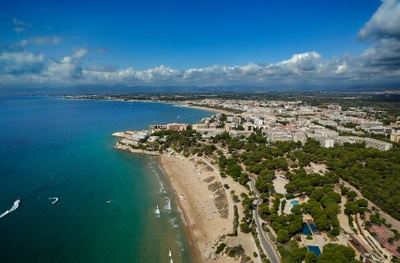
Spain was a neutral country and did not take part in the conflict. Its territorial waters were excluded from warfare up to three nautical miles from the coast, a circumstance that merchant vessels took advantage of by sailing under protection and avoiding the dangers of international waters. German submarines lay in wait at the outer limits of these protected waters, ambushing merchant ships when they ventured into unprotected areas. The Gulf of Sant Jordi, stretching between Cape Salou and Cape Tortosa, was one such hotspot. Merchant ships often took the risk of sailing directly from one headland to another instead of following the coast, frequently entering international waters and becoming targets of German submarine attacks.
Three German U-boat submarines operated along this stretch of coast: U-34, U-35 and U-64. Their wartime activity is documented by the sinking of at least ten ships in the Gulf of Sant Jordi between 1916 and 1917.
The attacks targeted merchant vessels transporting supplies to powers at war with Germany. The usual modus operandi consisted of locating a ship suspected of serving an enemy nation, warning it with a siren and cannon fire to make it stop, and demanding its documentation. If it was confirmed that the vessel belonged to the opposing side, the crew was given a brief courtesy period to abandon ship before it was sunk.
Not all crews survived. If a ship attempted to flee or resist, it could be shelled or torpedoed without hesitation. Some sailors who abandoned their ships managed to reach the beaches of Salou, as did some of the victims who lost their lives in these attacks.
U-35 and Lothar von Arnauld de la Perière
U-35 was the most feared submarine of its time, and its actions could be seen and heard from Salou. This formidable U-boat has become a legend in naval warfare history, as it is credited with sinking the largest number of vessels ever, with more than 200 registered.
On 18 February 1917, it attacked four merchant ships: the Skogland, the Guido and the Giuseppe. The latter attempted to escape and was hit by a shell that killed a 17-year-old young coal trimmer and seriously injured another crew member. The last ship, the Janeta, managed to flee, taking refuge off Cape Salou and quickly reaching the Port of Tarragona, with a smoking cannon that had been used in its defense.
German submarine SM U‑35 moored alongside the merchant ship Roma in the port of Cartagena, 21 June 1916. Source: Wikimedia Commons (public domain)
The Spanish Civil War (1936–1939)
During the Spanish Civil War, the Catalan coast witnessed the activity of Italian submarines. The rebel faction, which maintained close ties with the Italian government, used these submarines to patrol coastal waters with the aim of disrupting the transport of weapons, troops and, above all, fuel destined for Republican forces.
Initially crewed by Italian sailors, the submarines were gradually taken over by Spanish crews, improving their effectiveness thanks to their detailed knowledge of the coastline and potential targets. Over time, the rebel side acquired the submarines and began operating them independently.
Submarine activity had a limited impact in the waters around Salou, mainly due to coastal defenses, which enabled rapid responses and the issuance of alerts to nearby towns. As a result, some attacks failed and revealed the submarines’ positions.
In addition, the identification system used by the submarines proved inefficient: it relied on cards with profiles of target vessels, including their names and colors. Many ships altered their appearance to avoid recognition.
The local population also became involved in maritime vigilance, monitoring the waters near the ports using fishing boats, which were not considered military targets.
Submarines such as Jalea, Tonicelli, Ferraris, Onice, General Mola II and General Sanjurjo patrolled the coast of Salou without sinking any vessels. The General Sanjurjo carried out significant reconnaissance missions, including the identification of coastal defenses such as machine-gun nests and artillery batteries, with the aim of mapping the coastline between Cape Salou and Cape Tortosa. These operations sought to identify less-protected strategic points for potential future landings.
Further reading:
Castellví, Josep M. & Guarro, Josep (2005). La guerra secreta del Mediterrani: submarins alemanys i vaixells aliats a la costa de Tarragona (1914–1918). Pagès Editors.
Cirera Saló, Maite. “La guerra civil a Salou,” in Estudis de Salou, 1. Recull (1996), pp. 29–44.
González Huix, Francisco J. (1995). El puerto y la mar de Tarragona durante la Guerra Civil, 1936–1939. Institut d’Estudis Tarraconenses Ramón Berenguer IV, Tarragona.